
Our Unforgettable Trip to the Okavango Delta
- Case Travel
- Mar 5
- 8 min read
On Monday 23rd February, my partner Adam and I took the eleven-hour flight from London Heathrow to Johannesburg. When we landed at 7am in Joburg, luckily our luggage had been checked all the way through to our next flight, so we simply went through transit immigration before heading to international departures, where we enjoyed a flat white and some snacks while waiting for our connecting flight to Maun in Botswana. At 12pm it was time to board our flight to Maun, a very quick one-hour twenty-minute journey on a small Airlink aircraft, which we were pleasantly surprised by. Despite the short flight they served lunch along with alcoholic and non-alcoholic beverages, which made the journey feel relaxed and easy.

Once we landed in Maun, we went through immigration, collected our luggage and were met by a representative from Wilderness – the company we would be staying with during our time in Botswana. They collected our luggage and escorted us to our next aircraft, as it was now time for our third flight of the day. This would be a very small light aircraft taking us to Chitabe, our lodge for the next two nights.
When we took our seats on the plane, the heavens decided to open and we experienced our first African storm of the green season. Thankfully the pilot decided to wait for the storm to subside before taking off. Once we were in the air, we were completely amazed by the views. Flying over the Okavango Delta instantly immersed us in the landscape and made us realise just how lucky we were to be experiencing this part of the world. It also gave us a fascinating preview of what the next few days in Botswana might hold. Around twenty minutes later it was time to land at Chitabe, but as we approached the airstrip the storm returned and we landed in heavy rain. It was slightly nerve-racking but also incredible to watch the skill of the pilot as she navigated the landing in such conditions.




We were the only passengers getting off at this stop and could see a safari vehicle waiting for us beside the airstrip. However, we were asked to stay seated on the plane for about ten minutes until the rain eased again. Once it slowed, we stepped out of the aircraft and met Duke, our guide for the next few days, who loaded our luggage and welcomed us warmly. Duke immediately offered us ponchos in case the rain started again and handed us cold drinks before we even left the airstrip.
Within five minutes he told us that on his drive to the Chitabe airstrip he had spotted a pride of lions nearby, as well as a separate mother lion with two cubs. Naturally, we went straight to look for them. Although we were unable to find the pride straight away, we did locate the mother lion and her two cubs. I was completely blown away by how close she allowed us to get. She was entirely unfazed by our presence and the vehicle. Duke explained that this was the first time the cubs had seen a safari vehicle up close, so they were slightly cautious but incredibly curious and playful.





We spent around four hours exploring the surrounding area searching for wildlife before finally arriving at the lodge around 7pm. There we were welcomed by the lodge manager and shown to our tent so we could quickly freshen up before heading to dinner. As the lodge is not fenced and animals can roam freely through the camp, guests must be escorted to and from their tents after dark. The entire lodge sits elevated on wooden walkways, which adds to the feeling of being completely immersed in the wilderness.
At dinner we sat with the manager, who joined us at the table while we enjoyed the meal. Starters and desserts were served to the table while the mains were buffet style, and it was a lovely opportunity to ask questions about the lodge, the surrounding conservation area and what it is like to live and work in such a remote environment. After nearly thirty hours of travelling, we were more than ready for bed. Our tent was incredible, with a huge super-king bed draped in mosquito netting, a help-yourself bar, an outdoor shower, a large seating area and a balcony overlooking the bush. During the night we could hear lions roaring in the distance alongside the constant chorus of frogs, yet despite the noise we slept deeply.
Our alarm call came at 5am, giving us around thirty minutes to get ready before breakfast at 5:30am. Breakfast was a continental selection of yoghurt, fruit, warm muffins, tea and coffee before we headed out on our first official game drive. Within ten minutes we came across the pride of lions Duke had mentioned the day before. Overnight they had killed a teenage giraffe and were now feasting. The pride consisted of around fourteen lions, including three mothers and several adolescents. Duke explained that the two dominant males were likely patrolling the surrounding area, protecting the younger cubs we had seen the previous day.


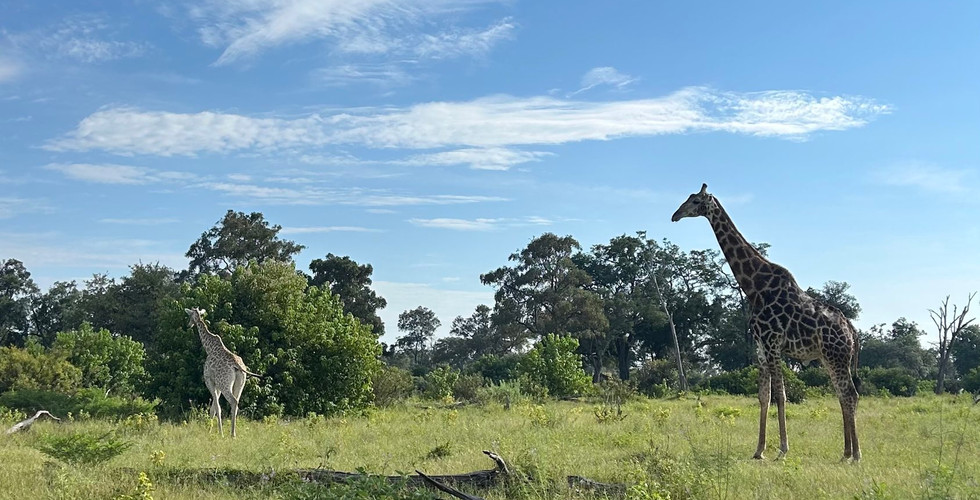
For the rest of the morning we searched for leopards but did not have much luck. Instead we came across giraffes, numerous bird species, impala and warthogs before returning to the lodge around midday. Brunch was served shortly afterwards and included eggs, bacon, meats and salads. We then spent a couple of hours relaxing by the pool before heading out again at 4pm for our afternoon drive.


During the evening drive we spotted giraffes, hyena and elephants before returning to the same pride of lions, which were still feeding on the giraffe carcass. This time one of the dominant male lions had returned and was sharing the food with the cubs. Dukes explained that this behaviour is actually quite unusual, as male lions do not always allow younger members of the pride to feed alongside them. After watching them for a while we stopped for a classic safari tradition: a sundowner in the bush. We opted for the Okavango’s very own gin and tonic before continuing our drive.
By this point darkness had fallen, which meant the drive became what they call a night drive. The guides use a spotlight to detect animals by the reflection of their eyes in the distance. On the way back to camp we spotted the same hyena we had seen earlier before returning to the lodge for dinner. That evening we sat with the other guests as well as Dukes and the lodge manager, sharing stories from the day while enjoying another excellent meal. At one point the same hyena wandered past the lodge below us, which felt like the perfect reminder that we were completely surrounded by wilderness.


The following morning brought another 5am wake-up call and our final game drive in the Chitabe concession. As we were flying to our next lodge later that morning, we spent the entire morning exploring before heading directly to the airstrip. During this drive we saw wildebeest, lions, giraffes, kudu, vervet monkeys and baboons before arriving at the airstrip for our short twenty-minute flight to the Vumbura concession, which is home to Vumbura Lodge and Little Vumbura. We would be staying at Little Vumbura.
When we landed we were met by our new guide, Max, who drove us a short distance to the boat station where we boarded our new mode of transport: the delta boat. The twenty-minute journey to the lodge was incredible and completely different from our experience at Chitabe. As we travelled through the narrow channels we passed lily pads, tall reeds and even spotted a hippo in the distance. When we arrived, several members of staff were waiting at the dock to welcome us before we walked along a long pontoon leading to the lodge itself. Little Vumbura is built directly within the delta, with elevated walkways and platforms surrounded by water and reeds.


Our tent here was slightly more rustic than at Chitabe but equally beautiful, with a balcony overlooking the water so that it truly felt as though we were immersed in the delta landscape. After a quick change we returned to the main area for lunch before heading out for our evening activity. At Little Vumbura guests can choose between game drives, boat safaris or mokoro rides. As we had spent the previous two days on game drives, we decided to try something different and headed out on a boat cruise through the delta.
We travelled quietly through the channels, observing the flowers, birds and distant hippos before stopping on the water for another classic Okavango gin and tonic as the sun began to set. It was an incredibly peaceful experience and completely different from the land-based safaris we had experienced so far.




The next morning began with another 5am wake-up call. This lodge offered a cooked breakfast before the drives, which Adam loved, although I personally struggled with the idea of hot food quite that early. We soon headed out on our morning drive, and this area was magical. The landscape here was filled with water, and the animals clearly thrived in it. Max quickly spotted lion footprints and began tracking them until we eventually came across a pride of female lions and their cubs.
What happened next was something Max explained was extremely rare. One by one, the lions began climbing a tree to scout for prey. The mother lion climbed first, followed by the cubs who began playing amongst the branches like oversized house cats. Watching them attempt to climb back down was equally entertaining, as some confidently climbed down head first while others struggled to figure out how to descend.


Later that morning we saw giraffes, zebras and elephants crossing the water before getting a flat tyre near a herd of elephants. Elephants are considered one of the most dangerous animals in the bush because they are unpredictable and particularly protective of their young. Max calmly instructed us to remain quiet and still until the herd moved past us. Thankfully they continued on peacefully, Max changed the tyre and we continued the drive.
After a short coffee stop we were surprised with a bush lunch, where staff from the lodge had prepared and delivered our meal directly to us in the middle of the wilderness. It was a surreal experience and one that perfectly captured the magic of safari.


That afternoon we experienced another traditional Okavango activity: the mokoro. A mokoro is a small wooden canoe pushed through the water with a long pole. While I was excited to try it, I was also slightly nervous knowing that hippos and crocodiles live in these waters. Max first explored the area ahead of us to ensure it was safe before we set off on what turned out to be an incredibly peaceful journey through the delta. From the mokoro you sit very low to the water, which allows you to see everything up close, including tiny frogs, birds and delicate water lilies. Our guide even made me a necklace from a lily pad flower.
Halfway through the journey we arrived at a floating pontoon set up for sundowners in the middle of the delta. Max once again became our bartender, mixing gin and tonics and serving snacks while we enjoyed the views. However, the approaching storm clouds soon reminded us that the green season weather can change quickly, so we returned to the lodge just as the storm began.



That evening we enjoyed another delicious dinner, and the team even surprised Adam by singing happy birthday and presenting him with a giant cake. After such a full day we were more than ready for bed.
Our final morning in the Okavango Delta did not disappoint. When Max asked what we hoped to see, we said leopard and wild dogs, and somehow he managed to deliver both. After following leopard tracks through the bush we eventually spotted a large male leopard resting in a tree with a very full stomach from his recent meal. While we were watching him, a hyena appeared beneath the tree, clearly hoping for leftovers.
Soon afterwards we encountered a large pack of African wild dogs playing in shallow water. They came incredibly close to our vehicle, which was an unforgettable experience. Wild dogs can travel up to fifty kilometres in a single day, so sightings are never guaranteed.




After a final coffee stop we drove to the airstrip and boarded our flight to Kasane Airport, marking the end of our time in Botswana.
Next stop: Zimbabwe.
More on that soon.


Comments